
Nikro Air Duct Cleaning in North Raleigh: A Homeowner’s Guide
The vacuum pulling debris out of your duct system is the single most important variable in a cleaning job, and most contractors won’t tell you the brand. They’ll quote a price, show up with equipment repurposed from a shop vac, and hope you don’t ask. Here’s the question that changes the conversation: “What equipment are you running?” If the answer is Nikro, you’re dealing with purpose-built machinery. If it’s a shrug, keep asking. We name our equipment because it matters, and this guide explains what Nikro does and how to confirm it’s being used correctly in your North Raleigh home.
What Is Nikro Equipment, and Why Should North Raleigh Homeowners Care?
Nikro Industries builds negative-air machines, HEPA filtration units, and collection systems specifically for the duct cleaning trade. These aren’t consumer vacuums with a longer hose. A negative-air machine creates pressure differentials that pull dislodged contaminants toward a HEPA-filtered collection point instead of pushing them into living spaces. That distinction matters in any North Raleigh home, but it matters more in the split-level and two-story layouts common across neighborhoods like Falls River and Bedford, where duct runs are longer and debris has more opportunity to migrate.
Nikro units are rated by CFM, or cubic feet per minute of airflow. A basic CFM spec check looks like this:
- Under 1,500 sq ft: A machine rated around 1,000-1,500 CFM is generally adequate for shorter, simpler trunk-and-branch systems.
- 1,500-2,500 sq ft: You want 1,500-2,500 CFM working in tandem with agitation tools, or dual-vacuum setups that let one machine pull while another maintains negative pressure.
- Over 2,500 sq ft: Higher-rated negative-air units, often run in combination, are necessary to keep adequate airflow across extended duct runs.
Most contractors won’t quote CFM numbers because their equipment can’t hit them. Asking the question exposes the gap quickly.
How Does Nikro Equipment Work Alongside Agitation Tools?
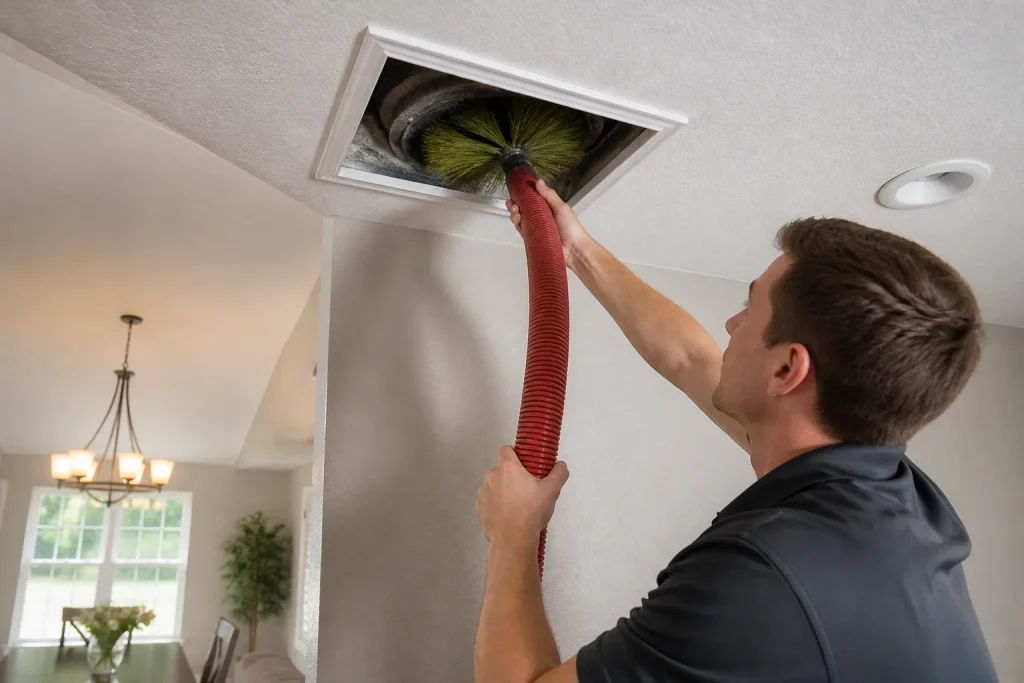
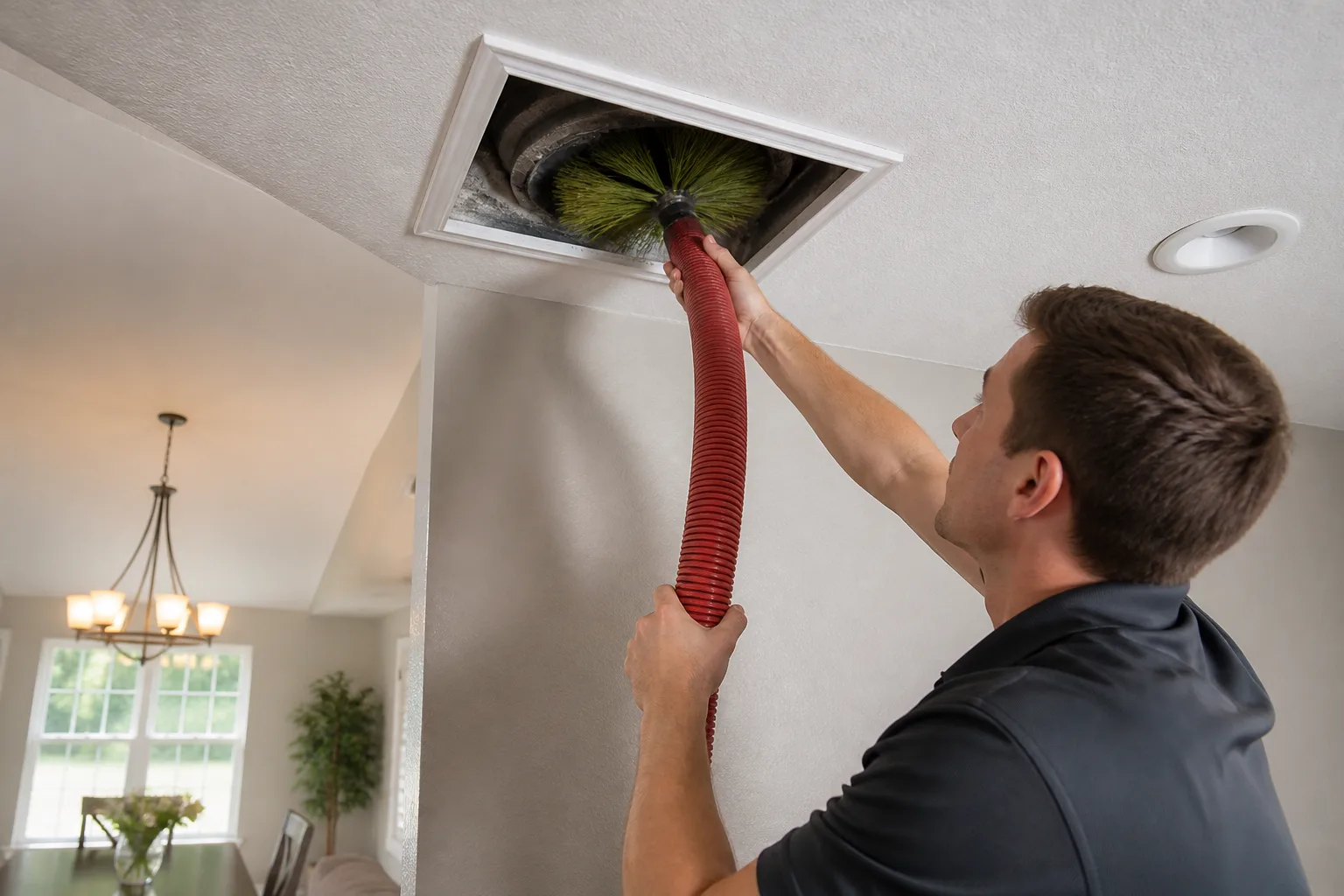
Vacuum pressure alone won’t dislodge debris that’s adhered to duct walls. That’s where agitation comes in: rotary brushes, air whips, and compressed-air tools that knock loose accumulated dust, construction debris, and biological growth from interior surfaces. The critical detail most homeowners never hear is that vacuum and agitation must run simultaneously. If a technician brushes a duct run without the negative-air unit running at the same time, loosened debris has nowhere to go except into the room, into the return, or deeper into the system.
Correct sequencing with Nikro equipment looks like this at each access point:
- The negative-air machine is running and confirmed to be holding pressure before any agitation begins.
- An access hole is cut (typically at the trunk or at strategic branch points) and sealed around the hose to maintain system pressure.
- Rotary brush or air whip is fed through the run while the vacuum continues pulling.
- The technician works from the furthest register back toward the collection point, so debris is swept toward the vacuum rather than past it.
- At each register, the technician confirms airflow is moving in the correct direction, then closes and reseals the access point.
In our experience across North Raleigh attics and crawlspaces, the most common failure we find isn’t a bad vacuum. It’s a vacuum running while nobody’s agitating, or agitation happening before pressure is established. Both redistribute exactly what you paid to remove.
What Should a Technician Using Nikro Equipment Actually Be Doing at Each Register?
Every register and return is an opportunity to verify the job is actually working, or a spot where shortcuts get taken. When Nikro equipment is being used correctly in a North Raleigh home, a technician should be doing the following at each opening:
- Pre-check: Confirming the return is pulling correctly before agitation begins, and noting any registers with weak or no airflow (a sign of a disconnected duct or a damper issue).
- Containment: Running Abatement Technologies air filtration on-site to capture any debris that escapes during the agitation and vacuum cycle, so nothing settles on furniture or floors.
- Agitation and vacuum together: Every brush pass or air-whip cycle running with the negative-air unit pulling from the same run.
- Photo documentation: Before-and-after shots of the access point or the interior of the run, so you can see what was actually removed rather than taking it on faith.
- Reseal: Properly sealing every access hole with mastic or foil tape, not leaving a gap for air to leak into an attic or crawlspace.
If you hear a technician working a run without asking “is the vac still pulling?”, that’s a signal. In North Raleigh’s older homes, where duct systems may have been retrofitted or patched over the years, that kind of check separates a real cleaning from a gesture in the direction of one.
What Questions Should North Raleigh Homeowners Ask Before Booking?
You don’t need a NADCA certification to ask the right questions. NADCA (the National Air Duct Cleaners Association) sets industry standards for equipment performance, containment, and verification that equipment manufacturers like Nikro build to. You can use those standards indirectly, just by asking:
- “What machine are you running, and what’s its CFM rating?” A contractor with Nikro equipment will answer immediately. A contractor with a repurposed shop vac will change the subject.
- “Are you running the vacuum and the brush at the same time?” The answer should be an unhesitating yes.
- “What containment are you using?” Look for a named HEPA filtration system, like Abatement Technologies. “We’re pretty careful” is not containment.
- “Will I get before-and-after photos?” A professional-grade process produces proof. If photos aren’t offered, the process probably doesn’t hold up to one.
- “What happens if you find damaged or disconnected ducts?” The honest answer requires a follow-up step: repair and sealing. Ask whether that’s handled in-house or referred elsewhere.
- “Is the quote per system or per vent?” Per-vent pricing rewards a contractor for counting openings while spending minimal time on each. Per-system pricing aligns with the actual scope of work.
Asking four or five of these questions before booking will filter out most of the low-bid operations that work North Raleigh’s newer subdivisions, where a fresh coat of paint hides a decade of construction dust sitting in the ductwork.
How Does Nikro Equipment Connect to NADCA Standards and Outcome Verification?
NADCA standards exist to answer a basic question: how does a homeowner know the work was done? They specify equipment performance requirements, containment procedures, and verification steps that professional cleaning should meet. Nikro equipment is engineered to those specs. Negative-air pressure maintained throughout agitation, HEPA filtration on collection, and documented before-and-after access point photos are all part of the standard, not add-ons.
What that means for you as a North Raleigh homeowner is that professional-grade equipment is the visible evidence of a standard being followed. A contract that specifies brand-name equipment and a per-system price, invoices the work, and documents it with photos is a contract that expects to be verified. A contract that quotes per-vent, offers a low teaser price, and doesn’t name a machine is one you’ll want to look at twice.
In our experience, the homes we’ve seen with the worst duct conditions aren’t the oldest ones. They’re the ones where someone paid for a cleaning twice and got a vacuum-and-call-it-done both times.
When to Call a Pro, and Related Services in North Raleigh
Some air quality issues are obvious. Visible dust blowing from a register seconds after the HVAC cycles on, a persistent musty smell that shows up when the heat comes on, or a recent home purchase in a North Raleigh neighborhood where the previous owner never addressed the ductwork are all signs it’s time to schedule an inspection. What you shouldn’t handle yourself is the cleaning itself: the equipment to do the job correctly is not consumer-grade, and attempting it with a shop vac can push more debris into the system than it removes.
Clean ducts are only the beginning of a full indoor air quality picture. If an inspection turns up loose or disconnected joints, air duct cleaning alone won’t solve the leak, and dryer vent cleaning is a related fire-safety concern that HVAC-only cleaners often skip. Pairing a duct cleaning with HVAC cleaning means the coil, blower, and drain pan get attention at the same time the ductwork does, rather than leaving a clean system fed by a dirty air handler. One call covers the whole system, from the air handler to the last register.
What happens when you call
- 1
A real person answersNo phone trees – you reach a local pro.
- 2
You get an upfront price rangeHonest numbers before anyone is dispatched.
- 3
A background-checked tech heads outLicensed & insured, dispatched right away.
- 4
You approve before work beginsNothing starts until you say go.
The Bottom Line
The vacuum is the variable. Nikro negative-air machines and HEPA collection units are built for this work, and the CFM rating should be matched to the size and layout of the duct system. Agitation and vacuum must run together, containment should be named, and before-and-after photos should exist without being requested. If a contractor can’t answer equipment questions, that’s your answer.
Our technicians have up to 10 years of experience with this equipment, and we can also integrate Honeywell and Aprilaire products into a long-term air quality plan when the inspection reveals a case for it. Before work starts, you’ll get one flat price per system and a written estimate that sets the final number.
If you’re in North Raleigh and need help, Air Duct Cleaning North Raleigh offers free estimates. Call (877) 820-8110. We answer 24/7. Fast dispatch from 7am to 7pm, Sunday through Friday.
Frequently Asked Questions
Nikro air duct cleaning refers to using Nikro Industries’ negative-air and HEPA-filtration equipment during a duct cleaning job. The equipment is purpose-built for duct work rather than repurposed from consumer or shop vacuum tools, which means it can maintain proper CFM and negative pressure across longer duct runs. Call (877) 820-8110 for an exact quote. Estimates are free.
Air duct cleaning in North Raleigh typically runs per system rather than per vent, and the written estimate sets the final price. The single most useful number to ask for is the CFM rating of the equipment being used, because a low quote from an underpowered machine isn’t a bargain. Call (877) 820-8110 for an exact quote based on your system size. Estimates are free.
Cheaper quotes almost always reflect cheaper equipment, shorter time on the job, or per-vent pricing that rewards a contractor for counting openings rather than cleaning each one. A vacuum that can’t hit adequate CFM leaves debris in the system, and agitation without simultaneous vacuum pulls redistributes what should be removed. Ask what brand and model the contractor is running. Call (877) 820-8110 for an honest per-system range. Estimates are free.
Most North Raleigh homes fall into a three-to-five year window under normal conditions, sooner after a renovation, a recent move-in, or if pets or allergy concerns are in the picture. The right interval depends on visible dust at registers, musty odors when the HVAC cycles, and what an inspection actually finds. Call (877) 820-8110 to talk through your situation. Estimates are free.
Written by the team at Air Duct Cleaning North Raleigh.
Need Air Duct Cleaning Help?
Call Air Duct Cleaning North Raleigh - the local pro we connect you with is licensed and insured, with free written estimates in North Raleigh.
(877) 820-8110